
DevOps engineer skills: What defines a true expert
Summary
Written by a Modsen DevOps team lead with hands-on experience building high-velocity engineering teams, this article offers a clear, practical breakdown of the DevOps engineer skills modern delivery depends on – from automation and cloud reliability to observability, security, and communication – and shows how these capabilities translate engineering into real business value.

Dmitry Bunas
Head of DevOps Department at Modsen
How to be a DevOps engineer – and what makes a great one?
It’s a question I hear from both engineers and business leaders – usually for very different reasons. Engineers want a roadmap. Businesses want results.
And both sides want to know which DevOps engineer skills actually make a difference.
Today, the role is often misunderstood: to some it’s “the pipeline person,” to others “the one who fixes things at 2 a.m.” But the real skills required for DevOps engineer roles are about something bigger – predictable delivery, fewer failures, clearer communication, and systems that support growth instead of slowing it down.
At Modsen, where I lead the DevOps department, I see every day how the right skills of a DevOps engineer transform a project: faster releases, better stability, and teams that finally operate as one.
So let’s make it simple – who a DevOps engineer really is today, which skills matter, and why those skills are worth far more to the business than any toolset.
DevOps engineer description and key skills ahead
Before we dive into the details, here’s a quick shortcut: if you want a simple, clear explanation of what a DevOps engineer actually does, I break it down in plain language in my another article. But let’s stay here for the deeper view.
The DevOps engineer description has changed faster than almost any other role in engineering. Not long ago, DevOps was mostly about “connecting Dev and Ops.” Today, the skills required for DevOps engineer roles stretch across automation, cloud architecture, observability, security, and – most importantly – business impact. This shift didn’t happen overnight. It’s an evolution.
The evolution of DevOps engineer skills and responsibilities
Stage | Title | Key focus |
|---|---|---|
2010-2014 | Automation Specialist | Build scripting, basic CI, toolchain setup |
2015-2018 | Pipeline Builder | CI/CD pipelines, QA integration, release management |
2019-2022 | Cloud Architect | Cloud platforms, IaC, Kubernetes, observability |
2023-2025 | Platform Engineer | DevSecOps, scalability, reliability, AIOps adoption |
2025-Future | System Strategist | Systems thinking, business awareness, leadership |
Modern DevOps engineers sit at the intersection of development, operations, and business thinking. Yes, they understand cloud, IaC, Kubernetes, CI/CD – but the key skills for DevOps engineer roles today also include communication, prioritization, and the ability to translate complexity into clarity for everyone else on the project.
As Vijaya Sekhar Godavarti (2025) notes, the role now splits into several practical paths:
Application DevOps engineers – automate the software lifecycle end-to-end.
Infrastructure DevOps engineers – build scalable, resilient cloud architectures.
Build & Release specialists – keep delivery predictable, stable, and fast.
But no matter the path, the foundation stays the same: automation, collaboration, problem-solving, and continuous learning. These aren’t just DevOps engineer skills –they’re behaviors. They shape how we think, make decisions, and help a product move forward.
The best DevOps engineers think in systems, act through automation, and measure success not by commits, but by reliability, adaptability, and impact.
At Modsen, I see it daily. The strongest engineers combine precision with curiosity and empathy – the three traits that turn technical skill into scalable solutions. That combination is what defines the next generation of DevOps talent.
So what makes these engineers so effective in practice? Let’s break it down.
Core DevOps engineer skills required to shape modern delivery
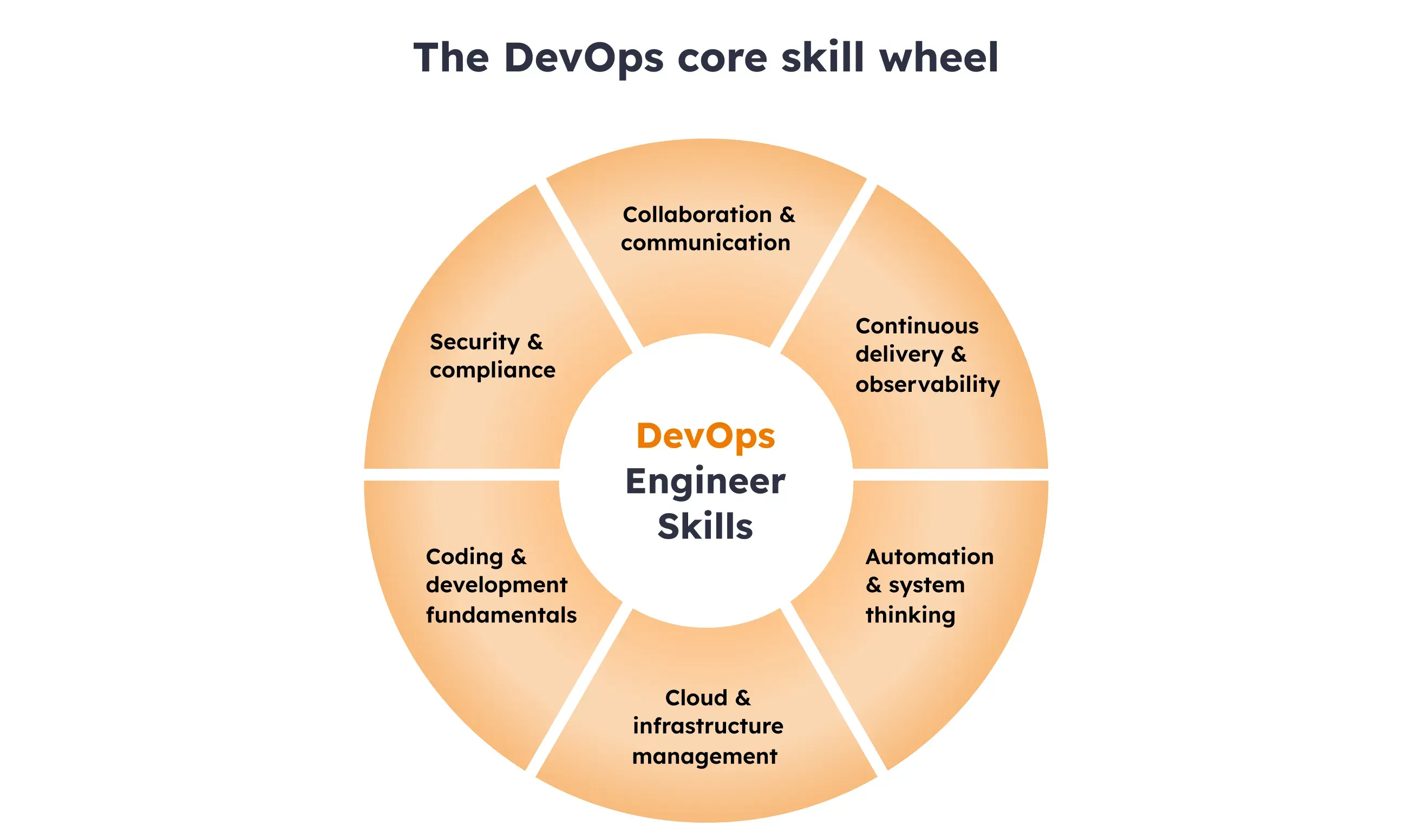
The tools are the engine – but the destination is value. Let’s chart that first. The DevOps engineer skills required today matter not because they’re fashionable – but because they remove friction: between teams, between ideas and release dates, between business goals and reality.
Every skill below solves a real business problem – speed, stability, cost, or clarity.
DevOps – where the moving parts of delivery become one coordinated motion.
1. Automation and system thinking
Among all DevOps engineer skills required today, this one creates the biggest gap between an average engineer and a truly impactful one.
Automation used to mean “write a script to save time.” Today it means something very different: design a system that makes the right decisions without waiting for a human.
Concepts like Infrastructure as Code or orchestration are simply ways to achieve this level of predictability. They’re not about tools – they’re about making the entire environment repeatable, stable, and quick to recover.
System thinking ties it all together. A strong DevOps engineer doesn’t automate tasks – they automate relationships between tasks, teams, and systems. That’s how companies move from “we fix things when they break” to “we improve things before they break.”
2. Cloud proficiency and infrastructure management
When business grows, the system must grow with it – smoothly and without burning money. That’s why cloud skills are now a core part of DevOps engineer requirements.
In simple terms, cloud proficiency means three things:
your platform scales when demand rises,
you don’t overpay for unused resources,
your service recovers quickly when something breaks.
A DevOps engineer is not “a person who deploys to AWS.” They are an architect of reliability and cost-efficiency.
3. Continuous delivery and observability
Continuous delivery sounds technical, but the idea is simple: release small updates often – not giant risky changes once in a while. Why this maters:
small changes are easier to test,
easier to roll back,
and reach customers faster.
Observability is equally simple: your system tells you what’s happening before it becomes a problem.
Forsgren’s Accelerate shows that teams with mature delivery practices deploy 46× faster and recover 96× quicker – a direct business advantage.
4. Security and compliance mindset
Security used to be “the last step.” Now it’s part of every step – because the cost of ignoring it is enormous. The technical skills required for DevOps engineer roles include:
automated security checks,
vulnerability scanning,
policy-as-code (rules the system follows automatically).
This protects your reputation, your customers, and your release schedule. Yes, it takes some effort – but when done right, it keeps teams fast by preventing the failures that truly stop companies.
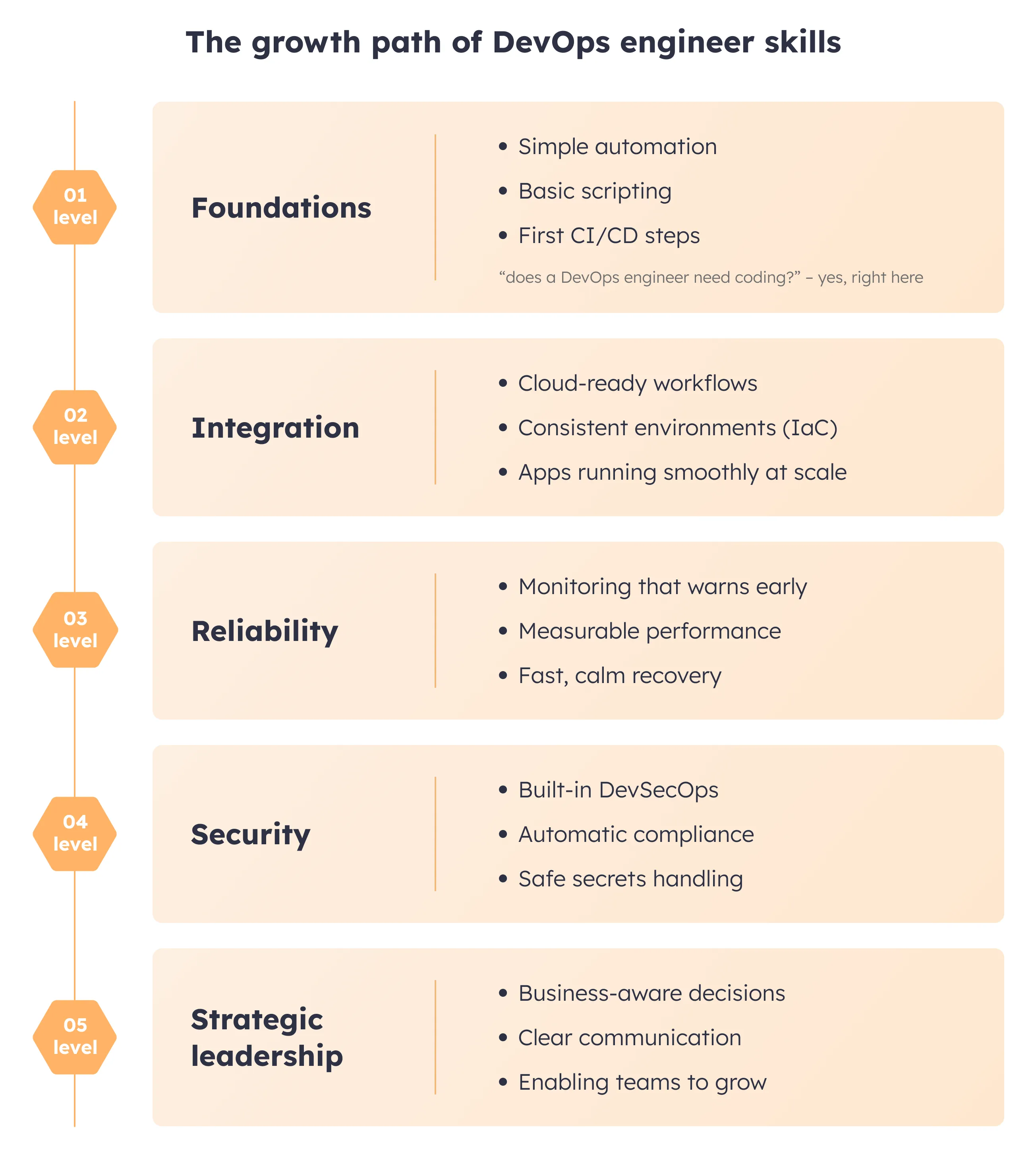
No shortcuts here – only the long, steady climb that defines the skill set for DevOps engineers who shape modern delivery.
5. Collaboration, communication, and business awareness
Tools don’t resolve misalignment – people do. That’s why the key DevOps skills today include clear communication and the ability to translate technical issues into business language. A strong DevOps engineer can explain:
why a delay happened,
how to avoid it next time,
and what the business impact is.
As Effective DevOps notes, trust and shared responsibility drive high performance more than any tool ever could. Great DevOps engineers automate systems – and conversations. They reduce friction across the entire team.
6. Coding and development fundamentals
Finally, does a DevOps engineer need coding? Yes – but not to build features. Coding gives DevOps engineers the ability to:
automate tasks,
investigate issues,
understand system behavior,
and prevent failures early.
Python, Go, Bash – the language matters less than the mindset. This is one of the essential DevOps engineer requirements, because it turns guesswork into insight.
Instead of conclusion
The DevOps engineer skills required today go far beyond tools. They shape the delivery engine every business relies on – fast, stable, cost-efficient, secure, and aligned with real goals rather than assumptions.
And a wave of recent reports – including the McKinsey outlook – confirms the same thing: in modern delivery, you simply can’t move forward without DevOps.
If any of this resonates – or raises new questions – feel free to reach out. Always happy to discuss DevOps, help with a project, or guide you through the early steps of mastering the discipline.
References & further reading
Books
1.
Kim, G., Humble, J., Debois, P., & Willis, J. (2016). The DevOps Handbook: How to Create World-Class Agility, Reliability, and Security in Technology Organizations. IT Revolution Press.
2.
Forsgren, N., Humble, J., & Kim, G. (2018). Accelerate: The Science of Lean Software and DevOps – Building and Scaling High Performing Technology Organizations. IT Revolution Press.
3.
Davis, J., & Daniels, K. (2016). Effective DevOps: Building a Culture of Collaboration, Affinity, and Tooling at Scale. O’Reilly Media
Academic Sources
4.
Godavarti, V. S. (2025). DevOps Engineering: Evolution, Roles, and Modern Practices. International Journal of Computer Engineering and Technology (IJCET), 16(1).
5.
Senapathi, M., Buchan, J., & Osman, H. (2019). DevOps Capabilities, Practices, and Challenges: Insights from a Case Study. Journal of Systems and Software, 157, 110395.
6.
Wiedemann, A., & Wiesche, M. (2018). Are You Ready for DevOps? Required Skill Set for DevOps Teams. European Conference on Information Systems (ECIS 2018).
Industry & Practice Reports
7.
Forsgren, N. et al. (2021). State of DevOps Report. Google Cloud & DORA.
8.
Modsen Engineering Practice Reports. (2025). Internal case studies and applied frameworks for high-velocity software delivery.

Get a weekly dose of first-hand tech insights delivered directly to your inbox